
One website calls it red light therapy. A research paper calls it photobiomodulation. Then a clinic mentions low-level laser therapy. If you are comparing treatments or equipment, it is reasonable to wonder whether these are different things.
Red light therapy and photobiomodulation often refer to overlapping applications, but they are not perfectly interchangeable terms. Red light therapy is the familiar name used in everyday conversation and product descriptions. Photobiomodulation, usually shortened to PBM, is the broader scientific term. It can involve red or near-infrared light delivered by LEDs or lasers.
That distinction helps you understand the terminology. It does not tell you whether two devices deliver the same exposure or have evidence for the same use.
Table of Contents
ToggleWhat Does Photobiomodulation Mean?
Photobiomodulation describes the use of light to influence biological activity. The word breaks down into three useful parts: photo means light, bio refers to living tissue, and modulation means changing or regulating a response.
PBM is generally described as a nonthermal approach: the intended biological response comes from light interacting with tissue, rather than from heating or destroying it. That does not mean every device stays completely cool during use.
A review in the Journal of the American Academy of Dermatology describes PBM using red and near-infrared wavelengths. These wavelength categories help explain why a product called a “red light therapy” device may also include light you cannot see.
Where Does Red Light Therapy Fit In?
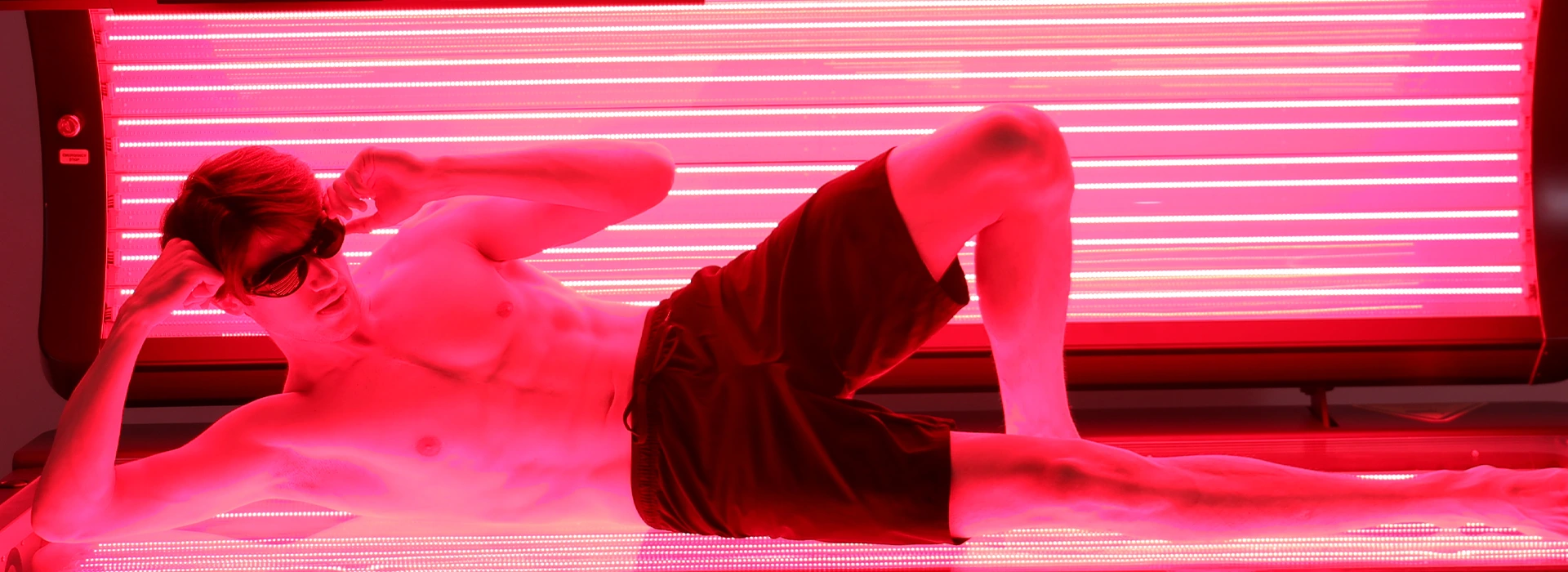
In wellness and skincare settings, “red light therapy” is often used as a convenient name for red and near-infrared PBM. A panel or full-body bed may combine visible red light with invisible near-infrared light while still being described simply as a red light device.
The two terms therefore overlap. The difference is in how much each name tells you: “red light” identifies a familiar part of the spectrum, while “photobiomodulation” describes a light-based biological approach.
A red glow alone is not enough to establish that a lamp is suitable for PBM. You still need to know its output, intended use, and operating instructions. A decorative red bulb and a purpose-built light therapy device should not be treated as equivalent because they look similar.
Can LEDs and Lasers Both Deliver PBM?
Yes. PBM is not restricted to laser devices. The academic paper Photobiomodulation: Evolution and Adaptation includes both low-power lasers and light-emitting diodes in its description of PBM.
LED arrays are commonly used in panels, masks, and beds to illuminate an area. Laser systems can deliver light in more concentrated beams. The way the light reaches the target depends on the design of the particular device.
This means “LED versus laser” is a separate question from “red light therapy versus PBM.” One identifies the light source; the other compares names used for the approach. Neither source is automatically the better choice for every application.
What About Low-Level Laser Therapy?
You may see the abbreviation LLLT in older papers or device literature. It can stand for low-level laser therapy or low-level light therapy. Read the study methods to find out which source was used rather than relying on the abbreviation.
The broader term PBM avoids tying the entire field to one light source. It does not mean that every LED and laser protocol can be substituted for another.
Does “PBM” Mean a Device Is Stronger or More Effective?
No. PBM is a technical term, not a performance rating. A product does not become more powerful, more suitable for commercial use, or better supported by research because its description uses a longer name.
Imagine comparing two full-body beds. One is advertised as a red light therapy bed; the other as a photobiomodulation system. Those labels do not tell you how evenly either bed illuminates the body, what output reaches the user, or which operating instructions apply.
The useful next step is to compare specifications under the same measurement conditions. Ask for the details behind the name.
What Should You Check When Comparing Devices?
Whether the product is called a PBM system or a red light therapy device, start with these questions:
- Which wavelengths does it emit? Look for the actual wavelengths in nanometers, rather than a description such as “advanced light technology.”
- What output reaches the user? Ask for irradiance in mW/cm², the measurement distance, and how measurements were taken across the exposure area.
- How is it intended to be used? Check positioning, exposure time, intensity settings, and whether the instructions specify continuous or pulsed operation.
- How much area does it cover? A targeted applicator and a full-body bed create different exposure setups, even if they share a wavelength.
- What supports the intended application? Look for evidence relevant to the device parameters and use, rather than a general list of PBM studies.
Electrical power consumption is also different from light output at the skin. A wattage figure on its own cannot tell you the exposure a person receives.
If you are comparing commercial red light therapy beds, request specifications for the exact model and configuration being quoted. That makes the comparison more useful than choosing between the words “red light” and “PBM.”
Can You Apply PBM Research to Any Red Light Device?
Not automatically. A study describes a particular setup: the light source, wavelengths, exposure, treatment area, schedule, and people studied. Those details matter when deciding how relevant it is to another device or application.
For example, findings from a small applicator used on a specific area should not be presented as proof that any full-body bed produces the same result. Sharing the term PBM does not remove those differences.
For everyday use, follow the instructions for your equipment rather than copying exposure times from an unrelated paper. Our red light therapy safety guide covers practical preparation and operating considerations.
Frequently Asked Questions
Is Near-Infrared Light Part of Photobiomodulation?
Yes. Near-infrared wavelengths are widely used in PBM. They are outside the visible spectrum, so brightness alone cannot tell you whether a near-infrared source is operating or how much light it delivers.
Is LED Light Therapy Always PBM?
No. LED describes the source, not the purpose or biological action. LEDs are used in many kinds of lighting and light-based treatments. Check the wavelengths, intended use, and protocol before treating the terms as equivalent.
Is a PBM Bed Different From a Red Light Therapy Bed?
The names may refer to the same type of equipment. They do not establish separate performance categories. Compare the specifications and instructions for the actual beds.
Does Nonthermal Mean You Will Feel No Warmth?
No. Nonthermal describes the intended PBM mechanism. A device may still produce warmth during operation. Follow its temperature and exposure instructions; feeling heat is not a reliable measure of the PBM dose.
Look Beyond the Name
In many conversations, red light therapy and photobiomodulation describe overlapping applications. Knowing that relationship helps you read research and product descriptions without mistaking a change in wording for a different technology.
When choosing equipment, move from the name to the details: wavelengths, measured output, coverage, instructions, and evidence relevant to the intended use.
Comparing beds for a spa, wellness center, or distribution project? Ask Magique Power for model specifications so you can evaluate the configuration that fits your plans.
