

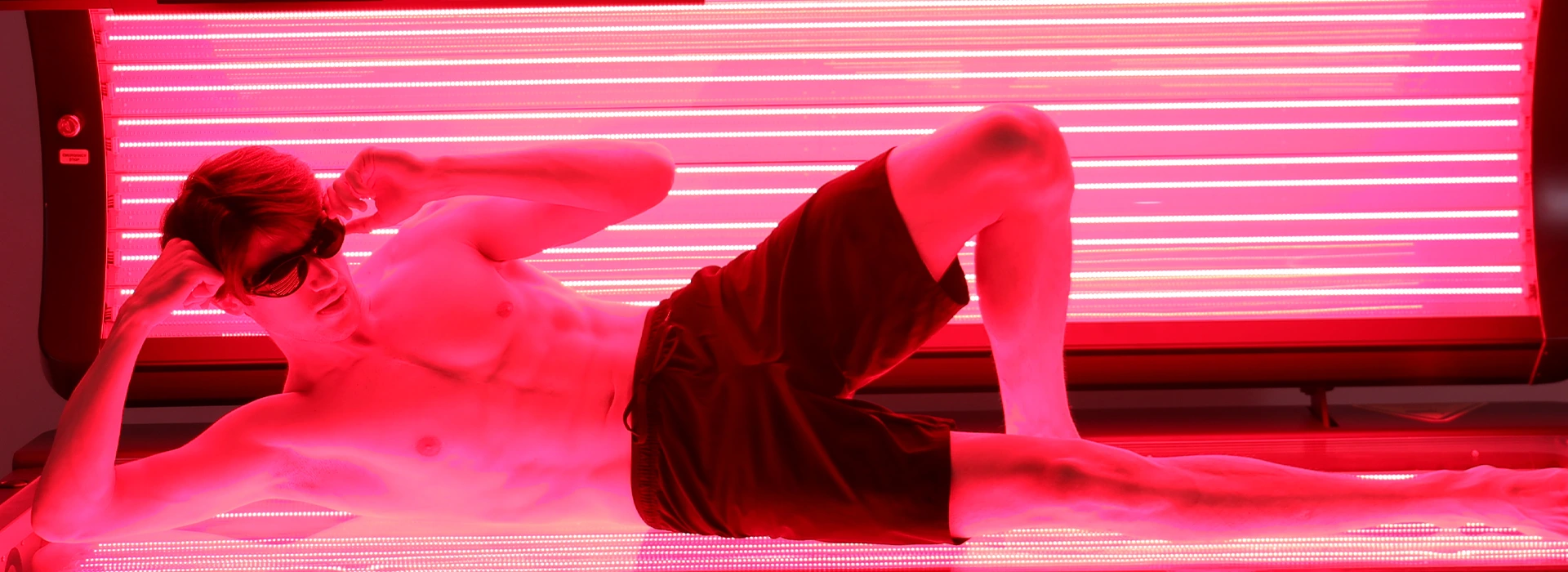
Before a red light therapy session, one question often comes up: do I really need the goggles, or can I just close my eyes?
Use the eye protection required by your red light therapy device. If its instructions specify goggles or shields, closing your eyes is not a substitute. If the instructions are unclear, ask the manufacturer before starting rather than choosing protection by appearance or comfort alone.
That applies whether you are using a panel at home or introducing a full-body bed at a wellness center. The useful question is whether the exact device, operating settings, and eye protection are appropriate for the way it will be used.
Table of Contents
ToggleDo You Need Eye Protection for Red Light Therapy?
For a bed or panel that requires protective eyewear, yes: wear the specified protection throughout the session. Do not remove it because the light feels comfortable or the timer is nearly finished.
There is no single eyewear rule that applies to every product sold as “red light therapy.” Devices differ in their wavelengths, output, treatment position, and intended use. Some incorporate eye shields into their design; others require separate accessories.
The American Academy of Dermatology’s red light therapy guidance advises users to follow the device instructions, including directions for eye protection.
For a commercial facility, this should become a clear operating instruction. Staff should know which eyewear belongs with each model and when it must be worn. Clients should not have to make that decision at the start of an appointment.
Can You Just Close Your Eyes During Red Light Therapy?
Closed eyelids should not replace protective eyewear required by the device. Closing your eyes may make bright light more comfortable, but it does not establish that exposure is within the device’s eye-safety limits.
Reducing glare and providing verified protection are different things. A client may notice less brightness with their eyes closed, yet that feeling does not confirm protection across the device’s full wavelength range.
- Follow the manual: If goggles are required, wear them even when your eyes are closed.
- Avoid improvised coverings: Do not substitute a towel or sleep mask for a specified accessory unless the manufacturer has confirmed that use.
- Keep protection in place: If the eyewear moves, pause the session using the instructed procedure before adjusting it.
For guidance on session settings, screening, and equipment care, read our red light therapy safety tips.
Why Red and Near-Infrared Light Need Different Consideration
Many red light therapy systems combine visible red light with near-infrared light. Near-infrared light is outside the visible spectrum, so looking at a device cannot tell you its complete optical output.
This matters when choosing protection. Eyewear that reduces visible brightness does not automatically provide suitable protection against the near-infrared wavelengths used by a particular system.
The International Commission on Non-Ionizing Radiation Protection explains that infrared exposure limits depend on factors including wavelength, exposure duration, and source size. Its visible-light guidance also addresses eye hazards from excessive exposure.
These principles do not mean every LED wellness session damages the eyes. They explain why “it is not UV” and “it does not look very bright” are insufficient reasons to skip the device’s protection requirements.
Before purchasing equipment, ask the supplier to identify the eye protection required for the exact configuration you are considering.
How to Choose Red Light Therapy Goggles
Start with the eyewear specified by the equipment manufacturer. If you need replacements, request the approved accessory or documented requirements before ordering a generic pair online.
- Check wavelength coverage: Confirm that the eyewear is suitable for the relevant red and near-infrared wavelengths used by the device.
- Ask for protection data: Request the applicable transmission or optical-density information and confirmation of suitability for the operating conditions. A label saying “RLT goggles” is not enough on its own.
- Check the fit: Goggles should stay in place when the user sits, reclines, or lies down in the instructed position.
- Confirm cleaning instructions: For shared use, verify which cleaning products and methods are compatible with the accessory.
- Plan for replacement: Keep an approved spare available so a missing or damaged pair does not lead to an improvised session.
Ordinary sunglasses are not a verified substitute. UV protection and dark lenses do not, by themselves, demonstrate suitable protection for a red and near-infrared therapy system.
There is also no universal optical-density number to recommend for every bed or panel. Eyewear selection needs to match the light source and operating conditions, rather than a number copied from an unrelated product.
Eye Protection for Red Light Therapy Beds and Panels
The operating position matters as well as the light source. A procedure written for a small panel should not automatically become the procedure for a full-body bed.
1. Full-body red light therapy beds
Before starting a bed session, check the eyewear after the client has settled into the prescribed position. A pair that feels secure while standing may shift when the client reclines or adjusts their head.
Explain how to stop the session or contact staff before switching on the equipment. If the goggles move, the client should pause the session using the instructed procedure instead of lifting the protection to reposition it under active light.
When comparing red light therapy beds, review the manual, treatment position, and eye protection requirements alongside size, controls, and other operating specifications.
2. Red light therapy panels
With a panel, keep the prescribed distance and orientation consistent. Do not move closer or change the treatment position simply because another user recommends it.
If a panel is used for different body areas, ask whether its eye protection instructions change with the setup. Turning the face away does not automatically remove the device’s protection requirements.
Facilities comparing red light therapy panels should request instructions for each intended arrangement, particularly when a room will accommodate several treatment positions.
A Practical Eye Protection Routine for Wellness Facilities
A useful routine is one that staff can explain clearly and repeat at every appointment. The following workflow can help facilities organize the process around the manufacturer’s instructions.
- Confirm the device and program: Use the instructions for the model being operated.
- Check for concerns before starting: Ask clients to disclose relevant eye conditions, recent eye procedures, light sensitivity, or medication concerns. Refer medical suitability questions to the appropriate clinician.
- Inspect the specified eyewear: Look for damaged lenses, loose straps, missing components, or other wear.
- Check the fit: Make the final adjustment with the client in the instructed session position.
- Explain the stop procedure: Tell the client what to do if the protection moves or they feel uncomfortable.
- Clean and store the accessory: Follow its cleaning instructions and remove damaged items from service.
If a client reports eye discomfort or a visual disturbance, stop the session. Do not continue by simply reducing the timer. New, persistent, or severe symptoms need prompt medical assessment.
This workflow is an operational suggestion. The equipment manual and individualized medical advice remain the basis for deciding how a particular device should be used.
What to Ask Your Equipment Manufacturer
For a spa, gym, or wellness center, eyewear belongs in the purchasing discussion. Resolving it before delivery makes staff preparation and replacement ordering much easier.
- Which eye protection is required for this exact model and wavelength configuration?
- Is the required protection included with the equipment?
- What documentation supports its suitability?
- Do the instructions differ between operating modes or treatment positions?
- How should shared eyewear be cleaned, inspected, and replaced?
- How can we order the correct replacement accessory?
Magique Power offers red light therapy beds and panels for professional buyers. When discussing a commercial installation, request model-specific operating instructions and accessory information together with the equipment quotation.
You can review our quality management information and contact Magique Power with your intended application, preferred equipment type, and destination market.
Frequently Asked Questions About Red Light Therapy Eye Protection
1. Can I keep my eyes open during red light therapy?
Do not deliberately look into the LEDs. Follow the device’s instructions for eyewear and eye position. Wearing goggles does not remove the need to follow the specified distance, orientation, and session time.
2. Do I need goggles if the session is only a few minutes?
If the device requires them, yes. A shorter session does not cancel its eye protection requirements. Do not create an unprotected “quick session” unless that use is explicitly covered by the manufacturer’s instructions.
3. Can I use tanning goggles for red light therapy?
Only if their suitability for the specific red light therapy device has been confirmed. Protection intended for UV tanning equipment does not automatically establish appropriate red and near-infrared protection.
4. Do contact lenses count as eye protection?
No. Contact lenses do not replace the protective eyewear specified for a therapy device. If you have questions about wearing contacts during a session, check the equipment instructions and ask your eye care professional.
5. What if I want to treat the skin around my eyes?
Do not remove required goggles or move them aside to expose more skin. Ask whether the device is intended for that area and follow its instructions. If the desired treatment conflicts with the protection requirements, do not improvise.
6. Does research on red light for eye health mean goggles are unnecessary?
No. Eye-directed photobiomodulation involves specific devices, patient selection, and treatment protocols. The FDA has authorized a prescription light-delivery system for a defined group of patients with dry age-related macular degeneration. That authorization does not establish that looking into a general wellness panel or bed is safe or beneficial.
The FDA’s review of the prescription eye-treatment device describes its specific intended use. It should not be used as a reason to disregard a different product’s safety instructions.
Conclusion
Eye protection for red light therapy should be chosen with the device, before the first session. Follow the model-specific instructions, use the specified eyewear, and keep the prescribed position and exposure time consistent.
For a commercial facility, turn those instructions into a repeatable staff routine. Before purchasing, ask the manufacturer to explain the eyewear requirements as clearly as the equipment specifications.
Discuss your red light therapy equipment requirements with Magique Power and request operating and accessory information for the model you are considering.
References
- American Academy of Dermatology. Is Red Light Therapy Right for Your Skin?
https://www.aad.org/public/cosmetic/safety/red-light-therapy - International Commission on Non-Ionizing Radiation Protection. Infrared Radiation.
https://www.icnirp.org/en/frequencies/infrared/index.html - International Commission on Non-Ionizing Radiation Protection. Visible Radiation.
https://www.icnirp.org/en/frequencies/visible/index.html - U.S. Food and Drug Administration. De Novo Review of the Valeda Light Delivery System.
https://www.accessdata.fda.gov/cdrh_docs/reviews/DEN230083.pdf
