

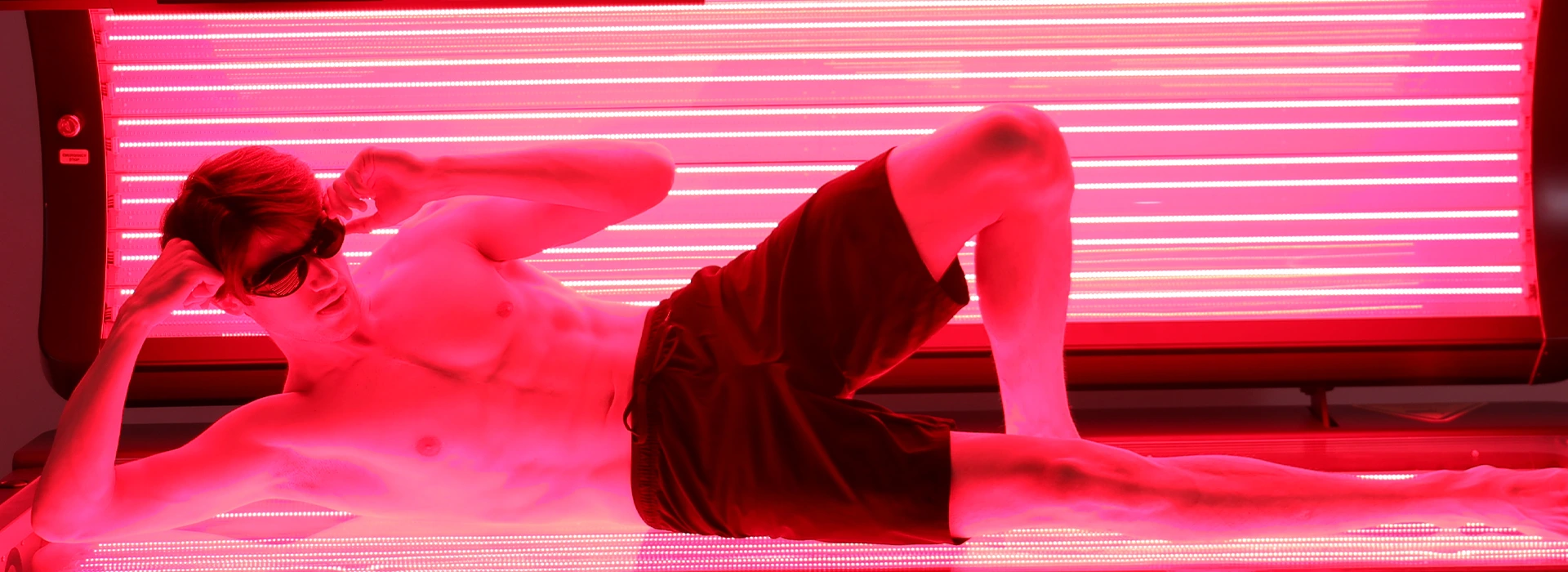
Red light therapy is often promoted as a painless way to achieve firmer, smoother-looking skin. Yet it can seem surprisingly simple: a client lies beneath red LEDs for a scheduled session, with no needles or recovery time.
Can red light therapy really encourage the skin to produce more collagen, or does the result depend on more than the color of the light?
The evidence is promising, but not automatic. Appropriately delivered red and near-infrared light may influence collagen-related cell activity and extracellular-matrix remodeling. Results still depend on skin condition, wavelength, dose, and consistent delivery.
Table of Contents
ToggleWhat Is Collagen and Why Does It Decline?
Collagen is the body’s most abundant structural protein, making up about 30% of total protein. It is widely distributed in skin, bones, muscles, tendons, ligaments, and other connective tissues.
What Does Collagen Do in the Skin?
Collagen has three connected roles:
- Provides firmness and structural support: Its fibers give the dermis tensile strength and help skin stay firm.
- Works with elastin and other extracellular-matrix components: It works with elastin and other support materials around skin cells to form the skin’s structural network.
- Is mainly produced by dermal fibroblasts: Fibroblasts build, organize, and maintain the collagen network in the dermis.
Why Does Collagen Decline?
Collagen decline is a gradual biological process, and it has several connected causes:
- Natural aging: With age, fibroblasts produce and organize collagen less effectively.
- UV exposure and photoaging: UV exposure accelerates collagen breakdown and photoaging.
- Oxidative stress: Oxidative stress disrupts normal cell function and collagen repair.
- Lifestyle and environmental factors: Smoking, poor sleep, stress, pollution, and unprotected sun exposure can speed visible skin aging and weaken skin recovery.
- Increasing activity of collagen-degrading enzymes such as MMPs: MMPs are enzymes that break down collagen. When their activity increases, collagen can be lost faster than it is replaced.
What Is Red Light Therapy and How Can It Support Collagen?
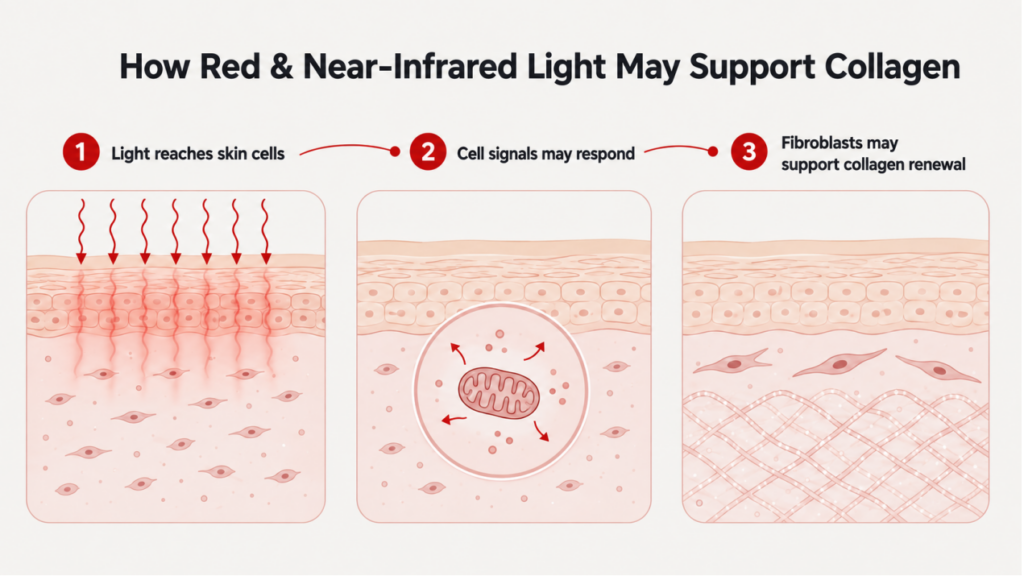
Red light therapy, or photobiomodulation, uses red and near-infrared light rather than UV. It does not place new collagen into the skin. Instead, it may influence cell activity involved in collagen renewal and the skin’s support network.
Step 1—Red Light Reaches Responsive Molecules in the Cells
When light reaches the skin, some of its energy may be absorbed by light-responsive molecules inside cells. One widely studied target is cytochrome c oxidase in mitochondria, the part of the cell that helps produce energy.
How much light reaches these cells can vary with the wavelength, device output, treatment distance, and the client’s skin characteristics.
Step 2—Cellular Signaling Changes
After this interaction, red light therapy may influence cellular signals linked to energy production, blood-flow regulation, and gene activity. These signals can affect how cells respond to repair and renewal needs.
This does not mean that a higher intensity or longer session will always deliver better collagen results. The amount of light received, also called the dose, needs to be appropriate for the treatment goal.
Step 3—Fibroblast and Extracellular-Matrix Activity May Respond
Fibroblasts are important because they produce and maintain much of the collagen in the dermis. Research indicates that light exposure may influence fibroblast activity, collagen synthesis, and the balance between collagen production and breakdown.
The extracellular matrix is the support material around skin cells. When fibroblasts and this support network respond well, the skin may gradually improve in firmness and texture. Results can still vary because devices, wavelengths, treatment schedules, and individual skin conditions are different.
Why Wavelength, Dose, and Device Design Make a Difference
Collagen-related outcomes depend on more than whether a device emits red light. Wavelength determines where light is most likely to interact with tissue, dose determines how much energy skin receives, and device design determines how consistently that dose is delivered.
How Wavelength Affects Collagen-Related Response
Red light, such as 630 nm or 660 nm, is commonly used for skin-focused treatment. Near-infrared wavelengths, including 810 nm or 850 nm, can reach deeper tissue layers.
For collagen support, the aim is to deliver useful light to fibroblasts in the dermis. Deeper penetration alone does not guarantee a better collagen response.
Why Dose Matters
Dose is the light energy the skin receives, influenced by irradiance, exposure time, distance, and coverage.
- Too little dose: Cells may not receive enough energy to trigger a meaningful response.
- An appropriate dose: Supports cellular signaling linked to fibroblast and collagen activity.
- Too much dose: Higher intensity or longer exposure may reduce the intended response rather than produce more collagen.
Wavelength and dose therefore make device design important. Masks, panels, and full beds can use similar light, but deliver it to the body differently.
Magique Power Red Light Therapy Devices
Magique Power offers red light therapy devices in both panel and full-bed formats, allowing clinics and wellness businesses to match equipment with their treatment coverage and service flow.
LUM-3000A Red Light Panel
The LUM-3000A is a large panel designed for focused treatment areas.
It has 3,000 W LED power, 600 × 5 W LEDs, standard 630nm, 660 nm, 810nm and 850 nm wavelengths, customizable spectrum options, and beam angles customizable to 30°, 60°, or 90° .
This panel format suits aesthetic clinics and beauty studios providing collagen-focused treatments for the face, neck, décolletage, hands, or other selected areas. Its adjustable distance and angle also make it a practical add-on in facial-treatment rooms.
Because the client can be positioned in front of or beside the panel, the LUM-3000A offers flexibility for businesses that do not need whole-body coverage in every appointment.
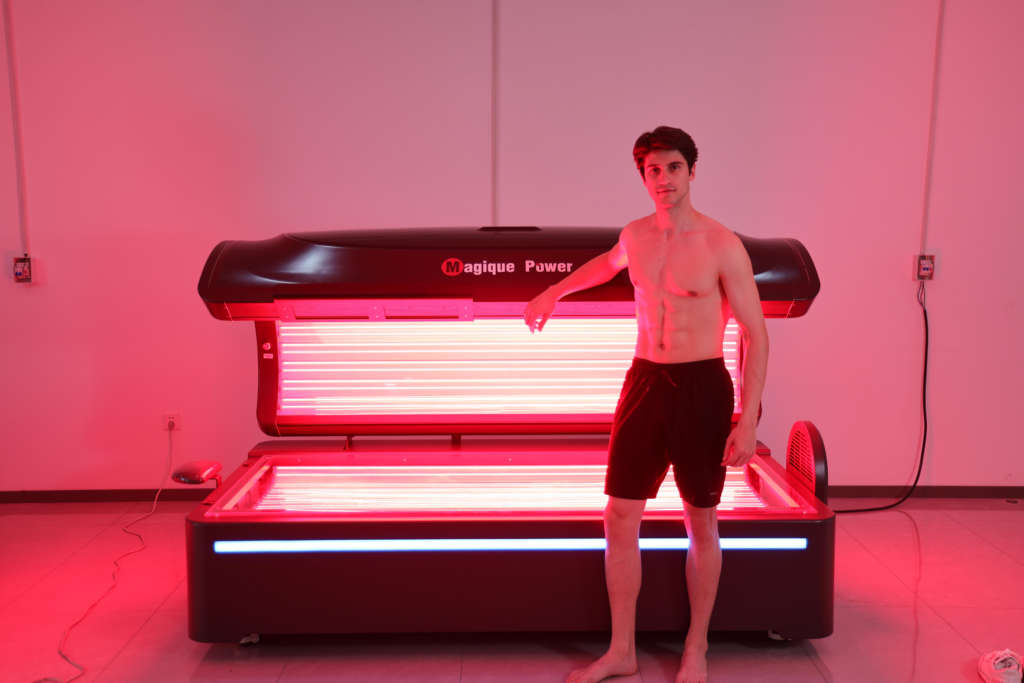
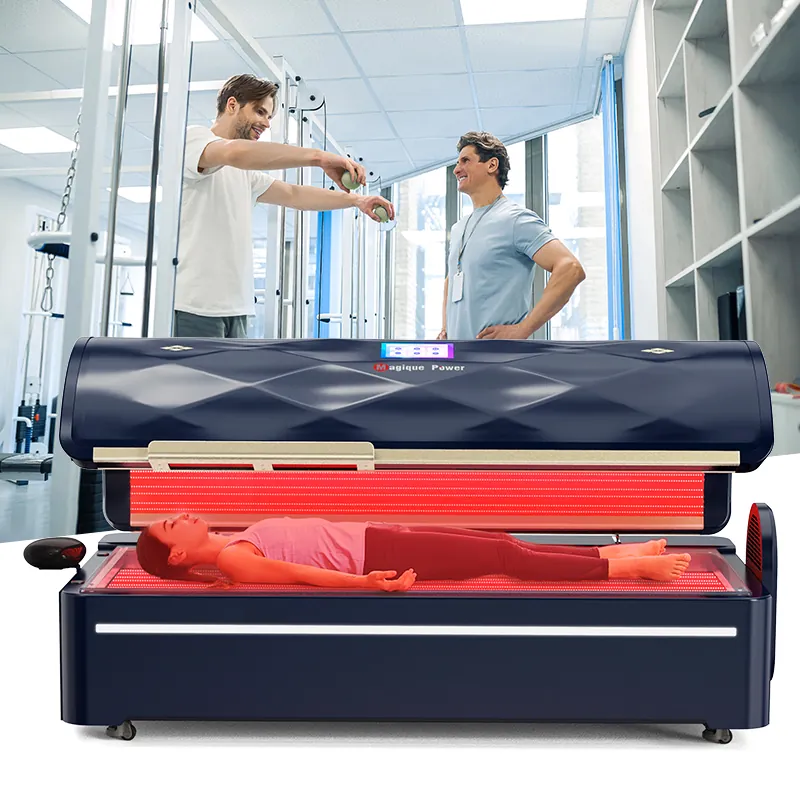
LUM-R5500 Full-Body Bed
The LUM-R5500 is designed for full-body sessions.
Its listed configuration includes 360-degree treatment coverage, an 129 mW/cm² irradiance measured zero distance , 633 nm, 660 nm, 810 nm, 850 nm, and 940 nm wavelengths, five preset modes, air cooling, and wireless-pad control.
This format suits wellness centers and aesthetic clinics offering whole-body skin-rejuvenation sessions. A collagen red light therapy bed can cover areas such as the face, neck, arms, chest, and legs without repositioning.
For businesses, the full-bed format also supports a more consistent service flow. Magique Power’s skin-rejuvenation page presents a 12-minute Boost Collagen quick mode for its red light bed range, which can help facilities build a defined collagen-focused session into their service menu.
Conclusion
Red light therapy may support collagen-related skin rejuvenation by influencing fibroblast activity and the dermal support network. Wavelength, dose, and device design determine how consistently light reaches the treatment area.
For targeted beauty services, a panel offers flexible positioning. For whole-body programs, a collagen red light therapy bed provides broader coverage in one session.
Contact Magique Power to explore a suitable panel or full-bed configuration.
