

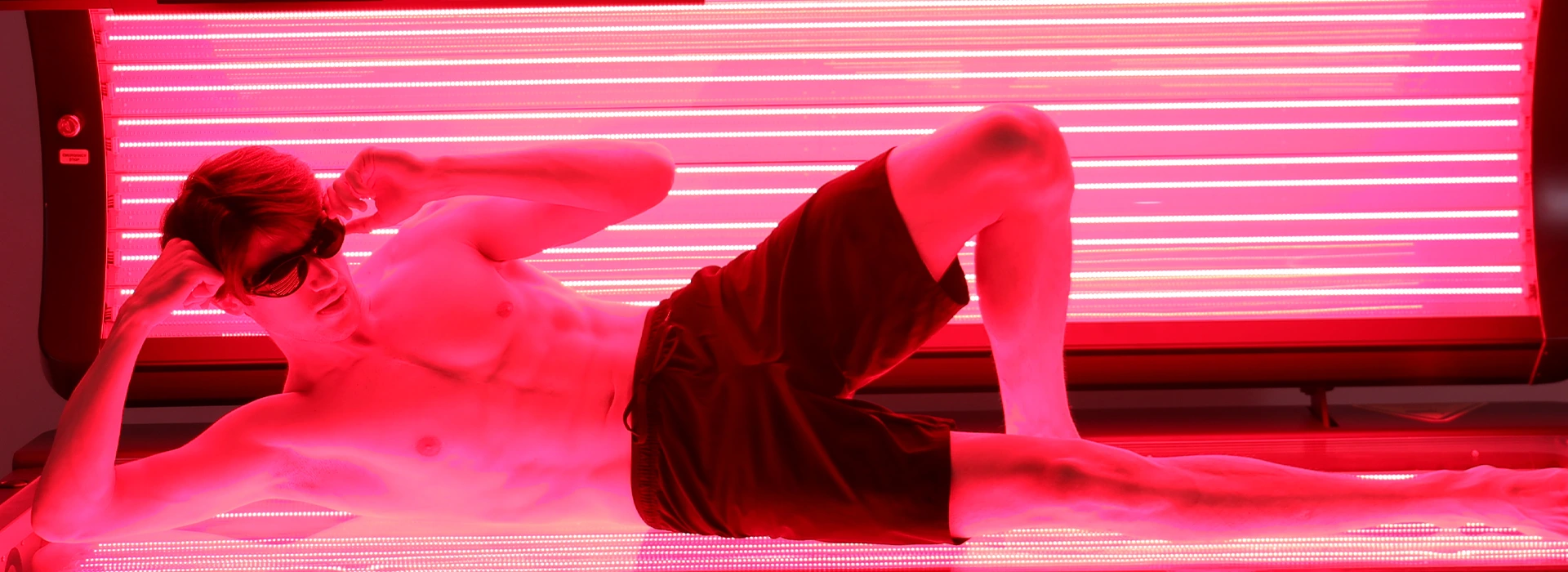
You have booked a red light therapy bed session, but the appointment confirmation does not mention clothing. Should you bring a swimsuit? Can you keep your underwear on? And do you need to change out of your workout clothes?
Choose clothing that leaves the intended treatment area uncovered, while following the bed’s instructions and the facility’s privacy and hygiene rules. Underwear or a swimsuit may be practical options where permitted. You do not need to assume that every full-body session requires complete undressing.
The aim is to arrive prepared, feel comfortable, and avoid putting an unplanned layer of fabric between the light and the skin you intend to expose.
Table of Contents
ToggleWhat Should You Wear in a Red Light Therapy Bed?
Start with the area you want exposed rather than looking for a special “red light therapy outfit.” For example, shorts leave much of the legs uncovered but cover the hips and upper thighs. A sports bra provides coverage while leaving other parts of the torso exposed.
Before your appointment, ask which clothing options the facility permits and whether you will have a private room for changing. That is more useful than following a dress code from an unrelated bed or salon.
- Underwear: A practical choice if permitted and comfortable for you. Remember that it covers part of the intended exposure area.
- Swimwear: An option for people who prefer more coverage. A one-piece swimsuit covers more of the torso than a two-piece.
- Shorts and a sports bra: Convenient after a workout, although they leave more skin covered than minimal clothing.
- Regular clothing: Suitable for traveling to the appointment, but you may need to change or move clothing away from the intended treatment area.
- No clothing: An option only where permitted, consistent with device instructions, and comfortable for the user. It should not be presented as a universal requirement.
Wear something easy to change out of. Complicated straps, several layers, and clothing that needs constant adjustment can make a simple appointment unnecessarily awkward.
Do You Have to Be Naked for Red Light Therapy?
There is no universal requirement to be naked for red light therapy. The appropriate level of coverage depends on the device, the intended exposure area, and the facility’s procedures.
“Full-body bed” describes the equipment’s coverage capability. It does not mean every user must expose every part of the body at every appointment.
If you prefer to keep underwear or swimwear on, discuss that before the session. Staff should explain what will remain covered and whether your choice fits the prescribed setup, without pressuring you to undress beyond your comfort level.
Can Red Light Therapy Work Through Clothes?
Fabric changes how much light reaches the skin beneath it. Some light may pass through a garment, but that does not mean covered skin receives the same exposure as uncovered skin.
Research on near-infrared transmission through clothing fabrics found that characteristics such as porosity, thickness, and moisture affect transmission. That research examined optical transmission for screening applications; it did not establish that red light therapy through clothing produces equivalent clinical results.
For a session designed around direct skin exposure, uncover the intended area as instructed. Do not assume that a thin white shirt is “transparent” to the device, or that fabric color alone tells you how much near-infrared light passes through.
Do not extend the session to make up for clothing. Without measurements for that garment and setup, you cannot reliably calculate a replacement exposure time. Follow the device-specific program instead.
What About Goggles, Jewelry, and Shoes?
Eye protection
Wear the eye protection specified for the bed. Ordinary sunglasses and closed eyelids should not replace required goggles or shields. If you are unsure what protection is needed, ask before the equipment is switched on.
Our guide to red light therapy eye protection explains what to check and why eyewear needs to match the device.
Jewelry and wearable accessories
Follow the facility’s instructions for necklaces, watches, fitness trackers, and other accessories. Items resting against the body can cover skin or feel uncomfortable when you lie down.
You do not need to assume that every metal item becomes dangerously hot during LED red light therapy. The relevant questions are whether the accessory interferes with the intended exposure, comfort, or the manufacturer’s operating instructions.
Shoes, socks, and towels
Ask whether shoes and socks should be removed before entering the bed. Follow the facility’s footwear rules rather than assuming they are the same as those for a standing booth.
A towel may be useful while changing, but do not place one between your body and a lower light array unless the manufacturer’s instructions allow it. Facilities should use a cleaning and contact-surface procedure appropriate for the exact bed.
Should You Remove Makeup, Lotion, or Sunscreen?
Check the preparation instructions before applying products to the area you plan to expose. If the protocol calls for clean, dry skin, arrive prepared or allow time to remove the specified products.
Avoid blanket claims that all makeup or moisturizers block every red and near-infrared wavelength. Formulations differ. Equally, do not assume that a product marketed as a “red light activator” is necessary for your session.
If you use a prescription topical product or have a question about light sensitivity, ask your prescribing clinician. Do not stop prescribed treatment simply to follow a general preparation checklist. The American Academy of Dermatology recommends discussing suitability and following device directions.
A First-Session Checklist
A short conversation before the appointment can answer most clothing questions. Confirm these details with the facility:
- What can I wear? Ask whether underwear, swimwear, or athletic clothing is permitted.
- Where do I change? Confirm the privacy arrangements and whether a robe is available.
- What should I bring? Check whether you need your own clothing, a hair tie, or other personal items.
- Is eye protection provided? Confirm that the correct accessory will be available.
- How should I prepare my skin? Ask about products already on the intended exposure area.
- How do I stop the session? Know the stop procedure before lying down.
Once positioned, check that clothing and protective eyewear are secure. If something needs adjusting during the session, pause the equipment as instructed. For a broader preparation overview, read our red light therapy safety tips.
For Spas and Wellness Centers: Explain the Dress Code Before Arrival
Clients should not discover the clothing policy while standing beside the equipment. Include it in the booking confirmation, together with changing arrangements, skin-preparation instructions, and the eye protection procedure.
Build the message around your specific model. A generic instruction such as “wear comfortable clothes” leaves the main question unanswered: which areas should remain uncovered during the session?
When selecting commercial red light therapy beds, request the operating manual, approved accessories, cleaning requirements, and user-positioning guidance. These details help your team turn the equipment instructions into a clear client experience.
Frequently Asked Questions
Can I wear underwear during red light therapy?
Yes, if it is consistent with the device instructions and facility policy. Underwear provides coverage, so the skin beneath it will not receive the same direct exposure as uncovered skin.
Can I wear leggings and a T-shirt?
You can arrive in them, but they cover much of the body. Ask whether you should change before a session intended to expose those areas. Do not rely on visible light shining through a garment as proof of an appropriate dose underneath it.
Is cotton better than synthetic fabric?
There is no universal fabric recommendation that guarantees the intended light exposure. Thickness, weave, layers, and wavelength matter as well as fiber type. For direct skin exposure, follow the instructions for uncovering the area.
Should clothing cover areas where I do not want to lose fat?
Do not choose clothing based on a promise that a general red light bed selectively removes fat from exposed areas. Any body-contouring claim needs evidence and authorization appropriate to the exact device and intended use.
Conclusion
What to wear in a red light therapy bed comes down to the intended exposure area, the equipment instructions, and your comfort. Confirm the clothing policy before arriving, use the required eye protection, and avoid improvising with extra time or unapproved coverings.
Planning a red light service for your facility? Contact Magique Power to discuss bed options and request model-specific operating information for your project.
References
- Saleem A, Canal C, Davis LAJ, Green RJ, Hutchins DA. Near Infrared Transmission through Various Clothing Fabrics. Journal of Textile Science & Engineering. 2013;3:129. Read the research paper.
- American Academy of Dermatology. Is Red Light Therapy Right for Your Skin?
